
You're not lazy. You're probably just vitamin D deficient.
By Shubham Desai
6/19/20264 min read


I want to tell you something nobody told me until I was 24 and had a blood test done somewhat on a whim.
I was averaging maybe six hours of sleep, three coffees a day, and still crashing hard by 2 PM every single afternoon. I assumed I was just one of those people who 'runs low on energy.' Turns out I had a vitamin D level of 14 ng/mL. The normal range starts at 30.
That one number explained three years of fog.
I'm writing this because I genuinely believe this is the most underdiagnosed problem in urban India right now, and almost nobody is talking about it in plain language. So here it is, as plainly as I can say it.
So why is India specifically so deficient?
Here's the irony: we live in one of the sunniest countries on earth and yet 70-90% of urban Indians are vitamin D deficient. That statistic sounds made up. It's from the ICMR National Nutrition Survey and multiple independent studies.
The reasons are surprisingly specific to how modern Indian life works:
• We work indoors. Most urban professionals spend 90% of their daylight hours inside an office, a car, or a flat.
• Melanin blocks UV synthesis. Darker skin requires significantly more sun exposure to produce the same amount of vitamin D as lighter skin — a fact almost no general advice accounts for.
• Our windows don't help. Glass blocks UVB rays, which are the specific rays your skin needs for D synthesis. Sitting by a sunny window does almost nothing.
• We cover up. Even when outdoors, most Indians are in full sleeve clothing for practical or cultural reasons, limiting skin exposure.
None of this is your fault. It's a design mismatch between modern Indian life and the conditions vitamin D synthesis actually requires.
The test, what to ask for, and what it costs
Before you buy any vitamin D supplement, please get a blood test first. The test you want is called 25-hydroxyvitamin D, written as 25(OH)D on most lab request forms. It's available at almost every diagnostic lab in India: SRL, Dr Lal PathLabs, Metropolis. It costs between 400 and 800 rupees depending on where you go.
Here's how to read the result when it comes back:
* Below 20 ng/mL means deficient. This needs attention.
* Between 20 and 29 ng/mL means insufficient. Your body is technically managing but not well.
* Between 30 and 60 ng/mL means sufficient. This is where you want to be.
* Above 100 ng/mL can be toxic. Vitamin D is fat-soluble and your body stores it. You can overdose.
That last point is why I'm emphasising testing before supplementing. It's not a formality. Vitamin D toxicity is real, and supplementing without knowing your baseline is genuinely not a smart move.
What I actually changed — and what happened
Once I got my result at 14 ng/mL, my doctor prescribed 60,000 IU of D3 once a week for eight weeks. That sounds alarming. It's actually a standard loading dose for someone who is properly deficient, not a daily supplement.
By week four I noticed something had shifted. The 2 PM crash wasn't hitting as hard. By week eight, I had my retest done. Level: 42 ng/mL. Sufficient.
I won't dramatise this and say my life changed. But the brain fog I had accepted as my baseline was noticeably better. That felt worth writing about.
What vitamin D actually does — and why low levels wreck your energy
Most people know vitamin D is 'good for bones.' That's accurate but it's about as useful as saying coffee is 'good for waking up.' It's technically true and tells you almost nothing about the mechanism.
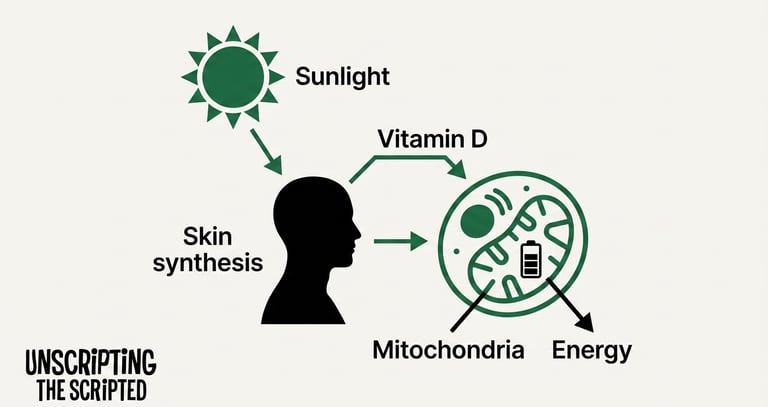
At a cellular level, vitamin D acts more like a hormone than a vitamin. Receptors for it are found in nearly every tissue in your body: your brain, your muscles, your immune cells, your gut lining. When levels are low, the downstream effects are widespread and often subtle enough that you blame them on other things entirely.
The specific energy connection is this: vitamin D plays a role in mitochondrial function. Your mitochondria are the structures inside each cell that produce ATP, which is the molecule your body uses as fuel. Low D impairs this process. Less efficient mitochondria means less energy produced per unit of food eaten. You're eating the same, sleeping the same, exercising the same, but running on a less efficient engine than you should be.
Add to that the fact that low vitamin D is associated with disrupted sleep architecture, higher inflammation markers, and lower serotonin production, and you start to see why one deficiency can make you feel like a completely different, worse version of yourself.