Why are you hungry again one hour after eating?
By Soham Shinde
6/19/20264 min read
The short answer: your blood sugar crashed
When you eat carbohydrates, your body breaks them down into glucose, which enters your bloodstream. Your blood sugar rises. Your pancreas detects this and releases insulin, which acts as a delivery vehicle to move that glucose from your blood into your cells, where it gets used as energy.
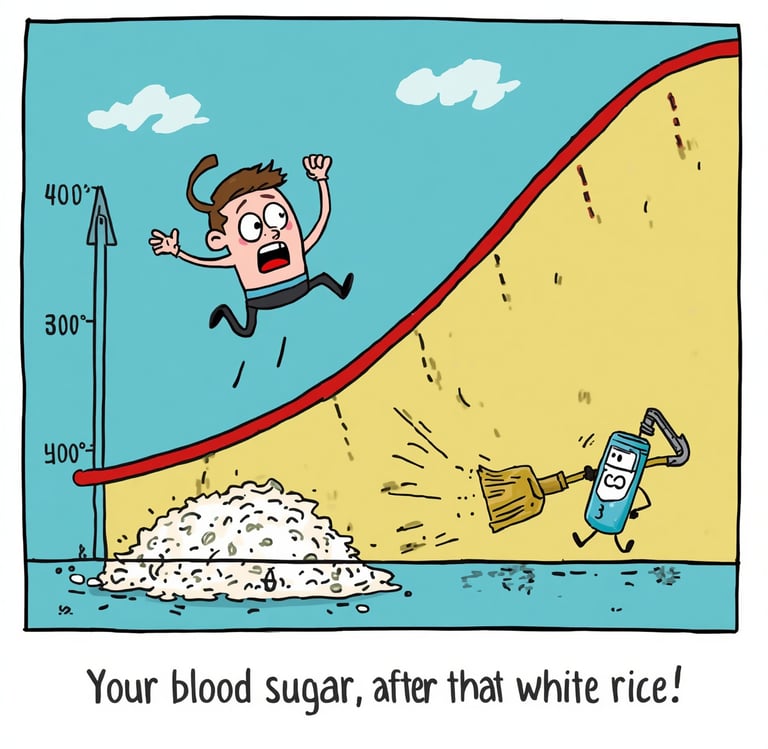
When this process works well and at a slow steady pace, you feel satisfied for several hours. When it goes too fast, you get a spike and then a crash. The crash is where your hunger comes from.
After a rapid blood sugar spike, your insulin response can be quite aggressive. Glucose gets cleared from the blood quickly and efficiently, sometimes to the point where blood sugar actually dips slightly below where it started. Your brain reads this as low fuel. It sends hunger signals. You eat again. The cycle repeats.
You were not actually hungry in any meaningful sense. Your blood sugar dropped and your brain panicked.
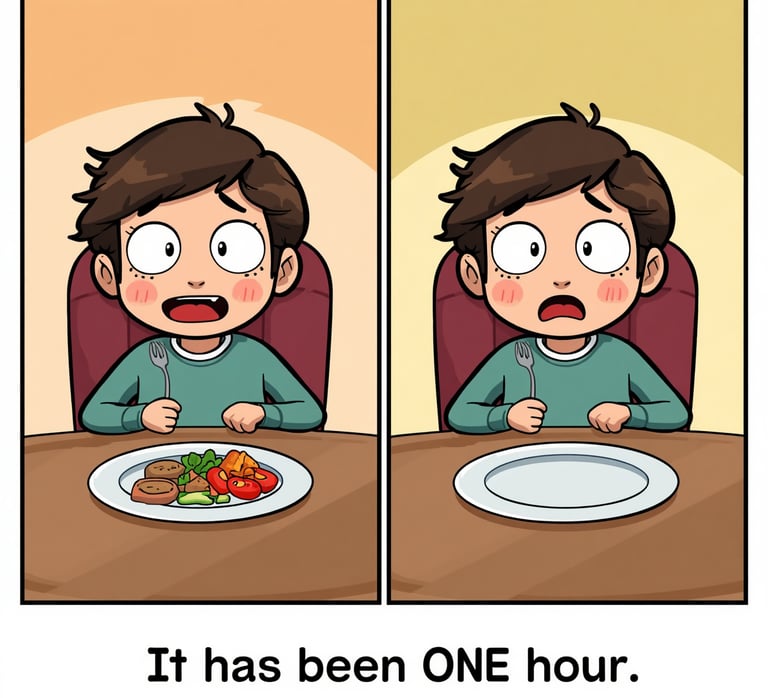
You just had a full meal. Rice, dal, sabzi, the works. You ate enough. You know you ate enough. And yet, roughly 45 minutes to an hour later, your stomach is making noise again and you're thinking about what's in the kitchen.
This is not a willpower problem. It is not greediness. There is a completely logical physiological reason why this happens, and once you understand it, you will look at what you eat very differently.
Why some foods do this more than others
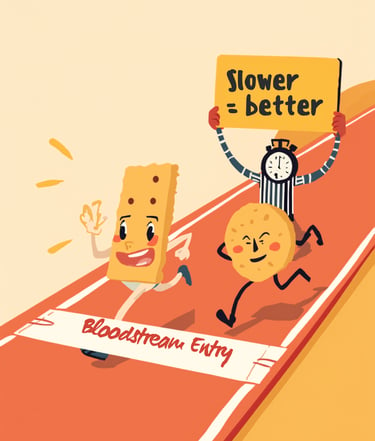
The speed at which a food raises your blood sugar depends on how quickly it gets digested and absorbed. Foods that break down very fast cause a steep spike. Foods that break down slowly cause a gradual rise. This is what the glycaemic index is actually measuring, not just how sweet something is.
Foods that cause fast spikes and crashes:
* White rice eaten on its own
* White bread and maida-based items like naan, paratha with little filling
* Sugary drinks, packaged fruit juices, energy drinks
* Most breakfast cereals marketed as healthy
* Biscuits, cookies, and most packaged snacks
Foods that cause a slower, more stable rise:
* The same white rice eaten with dal, curd, or sabzi that contains protein, fat, and fibre
* Whole wheat roti with a filling
* Eggs, paneer, legumes
* Oats cooked properly, not the instant kind
* Most vegetables, especially leafy ones
Notice the pattern. It is not that rice is the enemy. It is that rice eaten alone is processed very differently by your body than rice eaten as part of a balanced meal.
The ultra-processed food problem
This cycle is exactly what ultra-processed food companies figured out decades ago. Foods engineered to be high in refined carbohydrates and low in fibre and protein cause fast blood sugar spikes, quick crashes, and then hunger again, usually within the hour. A person who is hungry more often buys more. The hunger is not a bug in the design. It is close to a feature.
The specific combination that makes a packaged snack maximally addictive is refined starch plus sugar plus fat with almost no fibre or protein. That combination is extremely rare in nature. It only exists in processed foods. Your body has no evolved mechanism to feel satisfied from it in the long term.
What fibre actually does and why nobody talks about it properly
Fibre slows everything down. It literally slows the rate at which glucose enters your bloodstream by creating a physical barrier in your gut that has to be processed before absorption can happen. This is why eating an apple gives you a different blood sugar response than drinking apple juice, even though both contain the same amount of sugar. The fibre in the whole apple changes the entire absorption curve.
Most Indians get about 10 to 15 grams of fibre per day. The recommended amount is 25 to 35 grams. The shortfall is enormous and it has real consequences for hunger, energy, and blood sugar stability throughout the day.
Three things you can do starting today
One: never eat refined carbs alone. Rice with dal. Bread with eggs. Even a biscuit with a handful of nuts. Adding protein or fat to any carb slows its absorption significantly.
Two: eat vegetables first. Having a few bites of sabzi or salad before you start on the rice is one of the simplest ways to blunt the blood sugar spike from that meal. The fibre from the vegetables creates a buffer in your gut.
Three: check your snacks for fibre and protein. If a packaged snack has less than 3 grams of fibre and less than 5 grams of protein per serving, it will leave you hungry again within the hour regardless of how many calories it has.
Key Takeaways
* Post-meal hunger is usually a blood sugar crash, not genuine hunger
* Fast-digesting carbs alone cause spikes and crashes. Combining them with protein, fat, and fibre slows absorption.
* Fibre is the single biggest lever for blood sugar stability — most Indians get half of what they need
* Ultra-processed foods are engineered to cause fast crashes and more hunger
* Simple fix: never eat refined carbs alone, eat vegetables first, check snack labels for fibre and protein
Sources: NIH National Institute of Diabetes and Digestive and Kidney Diseases · American Journal of Clinical Nutrition (2022), glycaemic index and satiety · Cell Metabolism (2019), ultra-processed food and caloric intake · ICMR Dietary Guidelines for Indians 2024