
Monsoon Is When Your Vitamin D Quietly Bottoms Out
You will see less sun in the next three months than at any point all year. Your D level already knows.
Soham Shinde
6/26/20264 min read
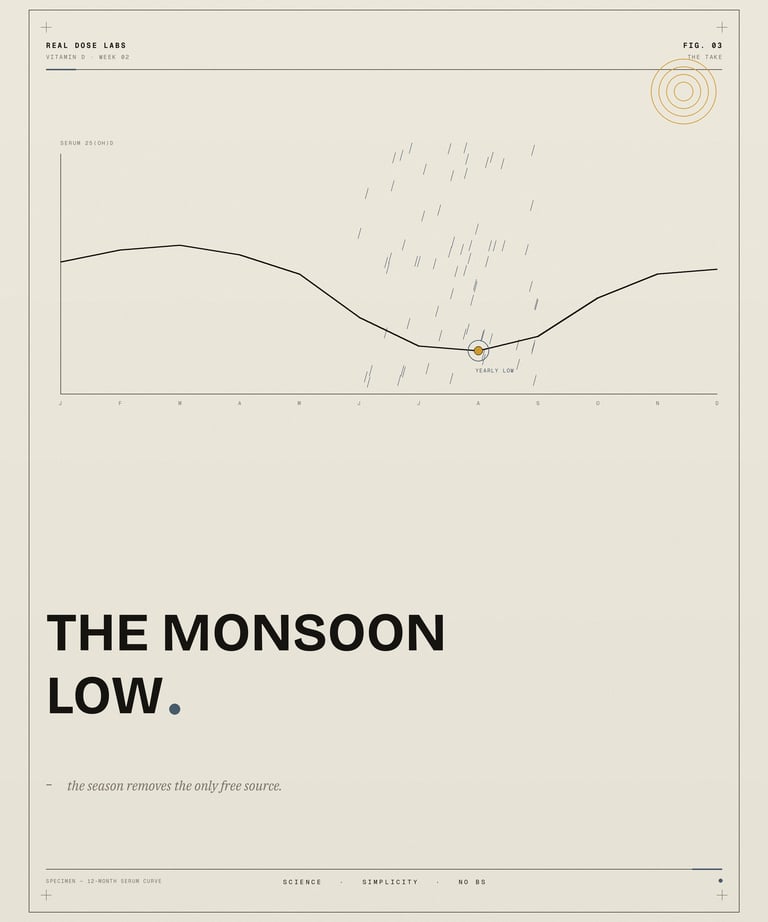
For the next three months, most of your city will be grey, wet, and indoors. Your Vitamin D level is about to drop to its lowest point of the year.
We treat monsoon as a mood. The slow mornings, the heavier sleep, the flatness that settles in somewhere around the third straight week of rain. We call it cosy, or we call it lazy, and we move on. What we almost never call it is what it often is, which is a measurable drop in a hormone your body cannot make without sunlight.
Here is the uncomfortable part. Most Indians are already deficient in Vitamin D before the rain even starts. Between 70 and 90 percent of us run low in the sunniest months of the year. Monsoon does not create the problem. It just removes the one free source we had left, right when our levels were already thin.
Why monsoon hits harder than you would expect
Your body makes Vitamin D when sunlight hits your skin. Not light through a window, not the glow of an overcast sky, but direct sun on bare skin for a meaningful stretch of time. That single sentence is the whole problem, because almost nothing about modern Indian life is built to allow it.
We work indoors. We commute covered. We step out, when we step out at all, in the early morning or after dark to avoid the heat. Add darker skin tones, which are beautiful and also need more sun exposure to produce the same amount of Vitamin D, and you already have a population running close to empty for most of the year.
Then monsoon arrives and takes away the sun entirely for weeks at a time. The clouds sit low, the days get shorter and dimmer, and the little outdoor time we did have disappears because nobody walks for pleasure in heavy rain. The result is a slow, quiet slide that almost nobody connects to a number on a blood report, because almost nobody checks.
You cannot out-supplement a deficiency you never tested for.
What low Vitamin D actually feels like
This is the trap. Vitamin D deficiency does not arrive with a clear label. It does not feel like a disease. It feels like ordinary life slightly dimmed.
It is the kind of tired that a full night of sleep does not fix. It is the low mood that has no obvious reason behind it, the one you start to assume is just your personality during the rains. It is catching every bug going around the office, the aches that sit in your bones rather than your muscles, and a general flatness that you learn to push through with more coffee and less expectation.
None of these prove a deficiency on their own. Plenty of things cause tiredness. But in a country where four out of five people are genuinely low, these signs are a strong reason to get a simple test rather than to keep guessing, or worse, to keep buying random supplements in the hope that one of them helps.
Why this is specifically an India problem
It is genuinely strange when you say it out loud. One of the sunniest countries on earth has one of the highest rates of Vitamin D deficiency in the world. The sun is not the issue. Our relationship with it is.
We have engineered sunlight out of daily life without replacing it with anything. There is no cultural habit of a daily walk in direct sun, no fortified-food system doing the work quietly in the background, and a long monsoon that closes off the option for a quarter of the year. So the deficiency is not an accident of biology. It is a predictable result of how we live now, and monsoon is simply the season when the maths catches up with everyone at once.
What to actually do about it
The fix is not dramatic, and it is not a new twelve-step routine. It is two unglamorous moves done properly.
First, test instead of guessing. A simple blood test for Vitamin D tells you more than any influencer protocol or any amount of self-diagnosis. You stop wondering and start knowing, and you give yourself an actual number to improve.
Second, if you are low, correct it with the right form, taken consistently through the indoor season. This is where most people quietly waste their money. They take the wrong form, or they take it for a few weeks, feel nothing, and stop. Deficiencies that built over years do not reverse in days, and the form genuinely matters.
You want D3, cholecalciferol, which is the same form your body makes from sunlight. Avoid D2, the plant-derived version your body uses far less efficiently. The common mistake is to wait until winter to react, by which point you have spent six months running on empty for no reason.
This is exactly why Real Dose makes a D3 strip and not a D2 tablet. D3, cholecalciferol, is the same form your skin produces in the sun, so your body recognises it. And the strip dissolves under your tongue, which means it bypasses your gut, the part of the process where a lot of ordinary tablets lose their way. No twelve-product routine, no proprietary blend. Just the most common deficiency in the country, corrected in a form your body can actually use, taken once a day through the months you need it most.
If you take one thing from this, let it be the timing. Do not wait for the slump to deepen. Monsoon is not the season to coast through and hope. It is the season to test, correct, and stay consistent, so that you reach the other side of the rains feeling like yourself rather than a slightly dimmer version of you.
When was the last time you actually had your Vitamin D tested, rather than guessed at it?
Science. Simplicity. No BS.
Tags: Vitamin D · Monsoon Health · D3 · Deficiency